Showing posts with label Unions. Show all posts

Sunday, May 29, 2011

More Trouble in Paradise

SCOTUS Makes It Official: California A Failed State - Walter Russell Mead
Let there be no mistake: when you produce so many criminals that you can’t afford to lock them up, you are a failed state. Virtually every important civil institution in society has to fail to get you to this point. Your homes and houses of worship are failing to build law abiding citizens, much less responsible and informed voters. Your schools aren’t educating enough of your kids to make an honest living. Your taxes and policies are so bad that you are driving thousands of businesses away. Your management systems must be fouled and confused to the max for you to create something so dysfunctional, so wildly beyond your means, that the Supreme Court of the United States (wisely or foolishly is another question) starts to micromanage your jails.

California used to be the glory of this country, the dream by the sea, the magic state. Now it produces so many criminals it can’t pay to keep them locked up.

Wednesday, May 25, 2011

Jobs and Migration

Why New York's future is fleeing - Fred Siegel
For more than 15 years, New York state has led the country in domestic outmigration: For every American who comes here, roughly two depart for other states. This outmigration slowed briefly following the onset of the Great Recession. But a recent Marist poll suggests that the rate is likely to increase: 36 percent of New Yorkers under 30 plan to leave over the next five years. Why are all these people fleeing?

For one thing, according to a recent survey in Chief Executive, our state has the second-worst business climate in the country. (Only California ranks lower.) People go where the jobs are, so when a state repels businesses, it repels residents, too.

Indeed, the poll also found that 62 percent of New Yorkers planning to leave cited economic factors -- including cost of living (30 percent), taxes (19 percent) and the job environment (10 percent) -- as the main reason.

Upstate, a big part of the problem is extraordinarily high property taxes. New York has the country's 15 highest-taxed counties, including Nassau and Westchester, which rank Nos. 1 and 2.

Most of the property tax goes toward paying the state's Medicaid bill -- which is unlikely to diminish, since the state's most powerful lobby, the alliance of the hospital workers' union and hospital management, has gone unchallenged by our new governor, Andrew Cuomo.

Saturday, May 21, 2011

Economic Crisis in Spain

Spain’s Socialist Utopia Mugged by Reality - Soeren Kern
Spain’s ailing economy too is a symptom of much broader problem, including the inability of the social welfare economic model to create jobs, as well as a highly paternalistic labor market that benefits an older generation seeking to preserve the status quo. Although Spain’s economic crisis has affected workers in all age groups, youth unemployment is more than double the overall jobless rate of 21.2 percent, the highest in the industrialized world. Around half of Spain’s youth are unemployed and the other half that is working often does so under highly exploitative employment conditions.

...

Opinion polls forecast devastating losses for the Socialists on May 22, as voters punish them for the government’s handling of the economic crisis and the painful austerity measures aimed at avoiding a debt default. Polls published in the centre-left El PaĆ­s and the center-right El Mundo newspapers predicted broad losses for the Socialists including in strongholds such as Barcelona, Seville, and the Castilla-La Mancha region. According to El Mundo, the Socialist Party is “on the edge of a catastrophe.”

Friday, March 4, 2011

State Budgets

Economists: State, local pension funds understate shortfall by $1.5 trillion or more - Peter Whoriskey
The pension funds for state and local workers in the United States are understating the amount they will owe workers by $1.5 trillion or more, according to some economists who have studied the issue, meaning that the benefits are much costlier than many governments and taxpayers thought.

Doubts about government pension accounting have been voiced by analysts for years, but with shortfalls in state and local pension plans exacerbated by the recession, the push to refigure pension fund shortfalls has gained political momentum.

The trillion-dollar gap arises from the government method of accounting, which several experts say significantly underestimates the cost of future pension payments.

Farewell, My Lovely - Tim Cavanaugh
At press time, California was being governed under a state of economic “emergency” declared by Brown’s predecessor, Arnold Schwarzenegger, in light of a staggering $28 billion budget shortfall expected in the next 18 months.

It gets worse. Medium-term unfunded liabilities for government employee pensions are pegged by the Legislative Analyst’s Office at $136 billion—and that’s a lowball figure. Legislative analyst Mac Taylor acknowledges in his current fiscal outlook report that the estimate leaves out billions in funding shortfalls at the pension funds for public school teachers and University of California employees. In the next 10 years, taxpayers will most likely be on the hook for somewhere between $325 billion and $500 billion. (Over the past five years, state revenues averaged $94.5 billion per year.)

How did this happen?

California’s state and local governments employ somewhere between 1.5 million and 2 million workers, representing 4 percent to 5 percent of the state’s total population. When they retire, all of those employees are contractually entitled to generous pension benefits—so generous that, collectively, they can’t be paid even by a pension system that ladles out more than $20 billion a year and is one of the largest investment pools on Wall Street.

Tuesday, February 22, 2011

Public Employee Unions

Watershed Moment in Wisconsin - Roger Kimball
Obama is so keen to preserve and nurture public sector unions because they are the lifeblood of the contemporary Democratic Party. To an astonishing extent, the unions are the government in many locales. They elect officials and then sit down to bargain with them over their salaries and benefits. Since they are essentially bargaining with themselves, they generally make out quite nicely. It’s a corrupt and ultimately unsustainable practice. Sooner or later, as Margaret Thatcher observed about socialism, they will run out of other people’s money. Many of us believe that day is nigh, but the unions and their enablers apparently have calculated that there is at least a little more ruin they can inflict.

Still, the issue in Madison is not just the future of public-sector unions. In my view — it’s one thing I agree with FDR about — they should once again be declared illegal, as they were in all states until the 1960s (currently about 40 percent of government workers are unionized). No, important as the fight over public-sector unions is, that battle is only one aspect of a much larger battle: the battle over the fate of individual freedom in a neo-collectivist age. As I said above, Obama has done us the great service of dramatizing the stark choice that faces us. At least since LBJ and his preposterously misnamed “Great Society” programs, the United States has been lurching down the collectivist path. The government has intruded itself in one aspect of life after the next, always with ruinous results. It is ironic, I suppose, that a crossroads should be reached in Madison, Wisconsin, a city named for that great patron of limited government James Madison. “The powers delegated by the proposed Constitution to the federal government are few and defined,” Madison wrote in Federalist 45.
Those which are to remain in the State governments are numerous and indefinite. The former will be exercised principally on external objects, as war, peace, negotiation, and foreign commerce; with which last the power of taxation will, for the most part, be connected. The powers reserved to the several States will extend to all the objects which, in the ordinary course of affairs, concern the lives, liberties, and properties of the people, and the internal order, improvement, and prosperity of the State.

The Means of Coercion - James Taranto
In any case, it seems to have escaped Krugman's and Drum's notice that the Wisconsin dispute has nothing to do with corporations. The unions' antagonist is the state government. "Industrial unions are organized against the might and greed of ownership," writes Time's Joe Klein, a liberal who understands the crucial distinction. "Public employees unions are organized against the might and greed . . . of the public?"

The "labor movement" in America has increasingly come to consist of people who work for government, not private companies. As the BLS notes, the union-participation rate for public-sector workers in 2010 was 36.2%, vs. just 6.9% for private-sector workers.

There is a fundamental difference between private- and public-sector workers. A private-sector labor dispute is a clear clash of competing interests, with management representing shareholders and unions representing workers. In the public sector, as George Will notes, taxpayers--whose position is analogous to that of shareholders--are usually denied a seat at the table:
Such unions are government organized as an interest group to lobby itself to do what it always wants to do anyway - grow. These unions use dues extracted from members to elect their members' employers. And governments, not disciplined by the need to make a profit, extract government employees' salaries from taxpayers. Government sits on both sides of the table in cozy "negotiations" with unions.
Collective bargaining in the public sector thus is less a negotiation than a conspiracy to steal money from taxpayers. The notion that this is "in the economic interests of the middle class" for government employees in Wisconsin and elsewhere to get above-market wages and extremely lavish benefits is just laughable. Sure, government employees are "middle class," but so are the vast majority of taxpayers who don't enjoy the special privileges that come from owning the means of coercion.

The Rubicon of Wisconsin - Charles Krauthammer
In the private sector, the capitalist knows that when he negotiates with the union, if he gives away the store, he loses his shirt. In the public sector, the politicians who approve any deal have none of their own money at stake. On the contrary, the more favorably they dispose of union demands, the more likely they are to be the beneficiary of union largesse in the next election. It’s the perfect cozy setup.

To redress these perverse incentives that benefit both negotiating parties at the expense of the taxpayer, Walker’s bill would restrict future government-union negotiations to wages only. Excluded from negotiations would be benefits, the more easily hidden sweeteners that come due long after the politicians who negotiated them have left. The bill would also require that unions be recertified every year and that dues be voluntary.

Recognizing this threat to union power, the Democratic party is pouring money and fury into the fight. Private unions have shrunk to less than 7 percent of the working population. The Democrats’ strength lies in government workers, who now constitute a majority of union members and provide massive support to the party. For them, Wisconsin represents a dangerous contagion.

Hence the import of the current moment — its blinding clarity. Here stand the Democrats, avatars of reactionary liberalism, desperately trying to hang onto the gains of their glory years — from unsustainable federal entitlements for the elderly enacted when life expectancy was 62 to the massive promissory notes issued to government unions when state coffers were full and no one was looking.

Obama’s Democrats have become the party of no. Real cuts to the federal budget? No. Entitlement reform? No. Tax reform? No. Breaking the corrupt and fiscally unsustainable symbiosis between public-sector unions and state governments? Hell no.

The Political Economy of Government Employee Unions - Thomas J. DiLorenzo
Thus, when government bureaucrats go on strike they have the ability to completely shut down the entire "industry" they "work" in indefinitely. The taxpayers will complain bitterly about the absence of schools and garbage collection, forcing the mayor, governor, or city councillors to quickly cave in to the union's demands to avoid risking the loss of their own jobs due to voter dissatisfaction. This process is the primary reason why, in general, the expenses of state and local governments have skyrocketed year in and year out, while the "production" of government employees declines.

Day of reckoning on pensions
- LA Times Editorial
The housing bubble and subsequent Wall Street collapse wreaked havoc on the nation's retirement savings, as many pension funds and 401(k) plans suffered losses of 30% or more. State and local governments are now facing huge unfunded pension liabilities, prompting policymakers to scramble for ways to close the gap without slashing payrolls and services. But a new report from the Little Hoover Commission in Sacramento makes a more troubling point: Many state and local government employees have been promised pensions that the public couldn't have afforded even had there been no crash.

...

A bipartisan, independent agency that promotes efficiency in government, the Little Hoover Commission studied the public pension issue for 10 months before issuing its findings Thursday. Much of the 90-page report is devoted to making the case that, to use the commission's blunt words, "pension costs will crush government." Without a "miraculous" improvement in the funds' investments, the commission states, "few government entities — especially at the local level — will be able to absorb the blow without severe cuts to services."

The problem is partly demographic. The number of people retiring from government jobs is growing rapidly, and longer life expectancies mean that a growing number of retirees will collect benefits for more years than they worked. But the report argues that political factors have been at least as important in driving up costs, starting with the Legislature's move in 1999 to reduce the retirement age for public workers, base pensions on a higher percentage of a worker's salary and increase benefits retroactively. The increases authorized by Sacramento soon spread across the 85 public pension plans in California.

Compounding the problem, the state has increased its workforce almost 40% since the pension formula was changed and boosted the average state worker's wages by 50%. Local governments, meanwhile, raised their average salaries by 60%. Much of the growth came in the ranks of police and firefighters, who increased significantly in number and in pay.

Tuesday, February 8, 2011

State Bankruptcy Debate

When States Go Bust - James Pethokoukis
It’s a solution of apparent Alexandrian elegance and simplicity: Empower America’s cash-strapped states to slice cleanly through a strangling knot of debilitating debt and government union cronyism by letting them file for bankruptcy. Long-term liabilities could be restructured, unaffordable labor contracts rewritten, fiscal health restored. No federal bailouts necessary.

This intriguing idea quickened last November when former House speaker Newt Gingrich gave it an animating shoutout during a speech at a Dallas think tank. That was followed by a detailed explanation in this magazine by David Skeel, a corporate law professor and bankruptcy expert at the University of Pennsylvania (“Give States a Way to Go Bankrupt,” November 29, 2010). As conservative Republicans on Capitol Hill began cooking up legislation to change the federal bankruptcy code, the concept exploded across the Internet—not to mention in Wall Street research departments.

Liberal bloggers, in particular, seemed to perceive the danger to a status quo where Big Labor elects state and local legislators who then return the favor by agreeing to contracts that, say, allow police officers to retire at age 50 with pensions equal to 90 percent of their highest salary. It’s a system that’s made government unions crazy powerful within the Democratic party while also helping states rack up some $3.5 trillion in unfunded pension and health care liabilities. (And that’s in addition to the anticipated $250 billion shortfall in state budgets over the next two years.) Kevin Drum of Mother Jones put it this way: State bankruptcy “promises to become a pretty serious battle. For Republicans it’s got everything: The tea parties will love it, it provides an alternative to raising taxes, and ... it helps defund a key Democratic interest group. What’s not to like?”

Surprisingly, quite a bit—at least among some Republicans and conservatives. In a January 24 session with reporters, House majority leader Eric Cantor brushed off the idea. “I don’t think [permitting states to declare bankruptcy] is necessary because state governments have at their disposal the requisite tools to address their fiscal ills.” The Virginia Republican added, “They have the ability to enter into new negotiations if there are any collective bargaining agreements in place. They have the ability to adjust levels of spending as well as revenues at the state level.”

A more pointed critique was offered by members of the highly respected free-market Manhattan Institute, Nicole Gelinas and E. J. McMahon, in the op-ed pages of the Wall Street Journal and other papers. Among their many objections to state bankruptcy: It would violate the constitutions of many states; it would damage the balance sheets of banks holding a quarter of a trillion dollars in state and municipal bonds; it might even cause such investor panic as to risk repeating the 2008 financial meltdown. “Bond-market brinkmanship and bankruptcy threats can’t save the states from themselves,” Gelinas wrote in the Boston Globe on January 23.

Obama to propose relief for states burdened by debt from unemployment benefits - Lori Montgomery and Brady Dennis
In recent years, states have been raising taxes, cutting services and firing workers in an effort to close record budget gaps opened by the recession. With the U.S. unemployment rate stuck at 9 percent or higher for nearly two years, 30 states - including California, Michigan and Nevada - have drained their unemployment insurance funds, forcing them to borrow to pay benefits to jobless workers.

Tuesday, December 7, 2010

The Economy - December 2010

The Economic Incompetence Of The Political Class - Charles W. Kadlec
The sovereign debt crisis now threatening Europe, as well as major American states and cities, discloses the sheer incompetence of a political class that has over-promised, under-delivered and squandered vast amounts of their citizens' wealth.

Greece, Ireland, Spain, Portugal, California, Illinois, Los Angeles and Chicago are simply the poster children for what happens when elected officials engage in reckless and irresponsible management of their economies, their banking system or their respective government's public finances.
U.S. Debt Clock
As predicted, The U.S. unfunded liabilities per taxpayer exceeded $1,000,000 during 2010. As Glenn would say, another grim milestone.
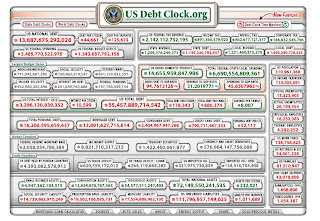
This is a good opportunity to quote myself:
We are promising benefits which cannot be delivered while simultaneously burdening future generations with expenditures they cannot afford.
The next time someone asserts that 'We are such a wealthy nation, surely we can afford to fund [insert pet social program here]" feel free to say "Well, no. Actually we can't. The total debt per U.S. household already exceeds $680,000. In addition, if you include unfunded future obligations for things like Social Security and Medicare, that number exceeds $2,000,000 per family. Just who exactly is going to pay that? Nobody can and nobody will. It's a Ponzi scheme and must eventually collapse like a house of cards."

Government liabilities rose $2 trillion in FY 2010: Treasury - by David Lawder
The biggest increase in net liabilities in fiscal 2010 stemmed from a $1.477 trillion increase in federal debt repayment and interest obligations, largely to finance programs to stabilize the economy and pull it out of recession.

A remedy for beggar states - George F. Will
A study by Northwestern University's Kellogg School of Management calculates the combined underfunding of pensions in the all municipalities at $574 billion. States have an estimated $3.3 trillion in unfunded pension liabilities.

Nunes says that 10 states will exhaust their pension money by 2020, and all but eight states will by 2030.

States' troubles are becoming bigger. Hitherto, local governments have acquired infusions of funds from federal budget earmarks, which are now forbidden. Furthermore, states are suffering "ARRA hangover" - withdrawal from the American Recovery and Reinvestment Act, a.k.a. the 2009 stimulus. With about $150 billion for state and local governments, it raised the federal portion of state budgets from about a quarter to a third. Also, in 2009 and 2010, states and localities borrowed almost $200 billion through the ARRA's Build America Bonds program, under which Washington pays 35 percent of the interest costs. Republicans, in another victory over the president in negotiations on extending the Bush tax rates, extinguished that program, which they say primarily produced more public-sector employees.

States taxing themselves to death
- Dick Morrix & Eileen McGann
High taxes kill states. There can be no better evidence than the 2010 Census. The states that lost House seats -- because they're shrinking, relative to the nation -- had taxes 27 percent higher than the ones that gained seats.

Of the seven states that don't have a personal income tax, four (Texas, Florida, Nevada and Washington) account for eight of the 12 seats apportioned to the fastest-growing states.

New York and Ohio lost two more seats. Other losers -- down one each -- are Massachusetts, Missouri, Michigan, New Jersey, Pennsylvania, Illinois, Louisiana and Iowa. What do they all have in common? High taxes.

Texas, with the second lowest taxes in the nation, gained four seats, Florida picked up two and Arizona, Georgia, Nevada, South Carolina, Utah, and Washington state each gained one. All have low taxes.

The states that lost seats ranked an average of 24th in taxes and had an average tax burden of $2,267 per capita (weighted more toward the states that lost more than one seat).

The states that gained seats ranked an average of 39th in taxes and had an average tax burden (weighted) of $1,788 -- 27 percent lower than the losing states.

People vote with their feet and flee to low-tax states. It's not the climate; it's the taxes.

The West and the Tyranny of Public Debt - Jacques Attali
The history of public debt is the very history of national power: how it has been won and how it has been lost. Dreams and impatience have always driven men in power to draw on the resources of others—be it slaves, the inhabitants of occupied lands, or their own children yet to be born—in order to carry out their schemes, to consolidate power, to grow their own fortunes. But never, outside periods of total war, has the debt of the world’s most powerful states grown so immense. Never has it so heavily threatened their political systems and standards of living. Public debt cannot keep growing without unleashing terrible catastrophes.

Anyone saying this today is accused of pessimism. The first signs of economic recovery, harbingers of a supposedly falling debt, are held up to contradict him. Yet we wouldn’t be the first to think ourselves uniquely able to escape the fate of other states felled by their debt, such as the Republic of Venice, Renaissance Genoa, or the Empire of Spain.

...

Still, accumulating excessive debt is far too easy. Spending naturally rises faster than revenue. But once the fatal spiral begins, how can a state escape disaster? There are only eight options: (1) higher taxes; (2) less spending; (3) more growth; (4) more lenient interest rates; (5) worse inflation; (6) war; (7) external aid; or (8) default. All eight options have been used in the past, but only one of them is both plausible and desirable today: growth. A growing economy (which raises tax revenue) permits the absorption of debt and restores sustainable public finances. Then borrowing can resume—if it will encourage further growth. Responsible governments do not finance their everyday expenses by borrowing, and they keep their investments at a level they can repay.

Catching On to the Entitlement Disaster - John Hinderaker
The picture with regard to Social Security is considerably bleaker, if you are a baby boomer:
The same hypothetical couple retiring in 2011 will have paid $614,000 in Social Security taxes, and can expect to collect $555,000 in benefits. They will have paid about 10 percent more into the system than they're likely to get back.
A reader who is highly sophisticated in financial matters emails:
Another way of looking at it is that on the most conservative assumptions they are receiving no more than a NEGATIVE return of minus 1.9% on their "contributions"! LITERALLY....if they had buried the "contributions" in the backyard they would be better off!

Saturday, October 2, 2010

California Budget Deficits

How to Save California: Outlaw Public Employee Unions - John Yoo
The one change that he said could restore the state's fortunes wasn't lowering taxes, cutting spending, or eliminating excessive regulations -- though these were all important. He said there was a deeper root cause: the power of the public employees unions. According to Wilson, public employee unions trigger a destructive dynamic. Public employee unions take money from their members and use them for partisan political purposes. They pressure government officials to cut them sweetheart deals, especially through things like job protections and pensions, that don't show up on the bottom line for years. They create a larger and larger interest group that demands more government spending and higher taxes, which drives out private entrepreneurship and swells their ranks even more. Reduce the power of the public employee unions, and you lower the size of government, reduce the costs of the state, and fix the looming pension problem.